
Multilingual website development: A website that speaks two languages and can be found in both.
Multilingual website development means each language gets its own URL, its own text and the markup that tells Google which version to show to whom. We build custom websites with the languages planned from the start, rather than bolting a translation plugin onto a finished site.
- A stable URL and its own titles for each language
- Languages and scope set out in a written quote
- Rentigo runs in full in Slovak and English
Slovak is sk, Slovenian is sl. Google will not guess.

Instead of promises, finished work.
Projects that fit this service. You can open each one.
What each language should have.
Its own URL
Each version has a permanent address that people and search engines can open directly.
Titles for that market
Page titles and search descriptions are separate for each language, not word-for-word copies.
Hreflang setup and sitemap
Every version points to all its counterparts with correct hreflang tags, and all of them are in the sitemap.
A switcher that stays on the page
Switching language opens the same page in the other version, not the home page.
Forms in the page language
Forms and buttons follow the language of the page, and enquiries land straight in your inbox.
One admin for all languages
You edit the content of every language yourself in one admin area, without touching code.
Built for several languages, or translated by a plugin?
| Built for several languages | Translation plugin | |
|---|---|---|
| URLs | Every language has its own address, and page names can be translated: /en/services, not /en/sluzby. | Depends on the plugin. Some translate in the browser, so the second language has no address. |
| Hreflang | Generated for every page as part of the site. | Better plugins add it, but it needs checking after changes. |
| Quality of the text | Each language has text that a person wrote or checked. | Often machine translation that nobody has read, until a customer does. |
| Differences between markets | A language can have its own offer, examples and pages. | Usually an exact mirror of the original. |
| Upfront cost | Higher, because you pay for design and development. | Lower, if you already have a site the plugin supports. |
A plugin is not a mistake. On an existing WordPress site, WPML or Polylang with checked text can serve you well for years. The trouble is unchecked machine translation and pages Google cannot find separately.
Three ways to structure URLs, and the mistakes to avoid.
Subfolder: company.sk/en/
Our tip for most companies. Everything stays on one domain, so your history with Google and your inbound links are not split.
Subdomain: en.company.sk
It separates the version technically, with more setup. It makes sense when another team runs it or it sits on another system.
Separate domain: company.at
Local customers see a familiar ending, but each domain starts from nothing in Google, so it suits a market you mean to stay in.
Mistake: the wrong language code
Hreflang takes language codes, and they are easy to get wrong. Slovak is sk, Slovenian is sl, and Czech is cs rather than cz. Google skips a code it cannot read.
Mistake: redirecting by location
Sending people to a version by IP address can lock them, and Google, into one language. Let the visitor choose.
Mistake: two languages on one URL
If the switcher only swaps text with a cookie or browser translation, Google usually sees one language, and the other never shows up in search.
Translation is the start. Localisation does the selling.
Translation turns sentences into another language. Localisation asks what a customer in that market needs: which words they type into Google, which terms and examples they recognise. On a bilingual website in Slovakia, the English version often speaks to foreign partners and expats and the Slovak one to local customers, so the two need not say the same thing.
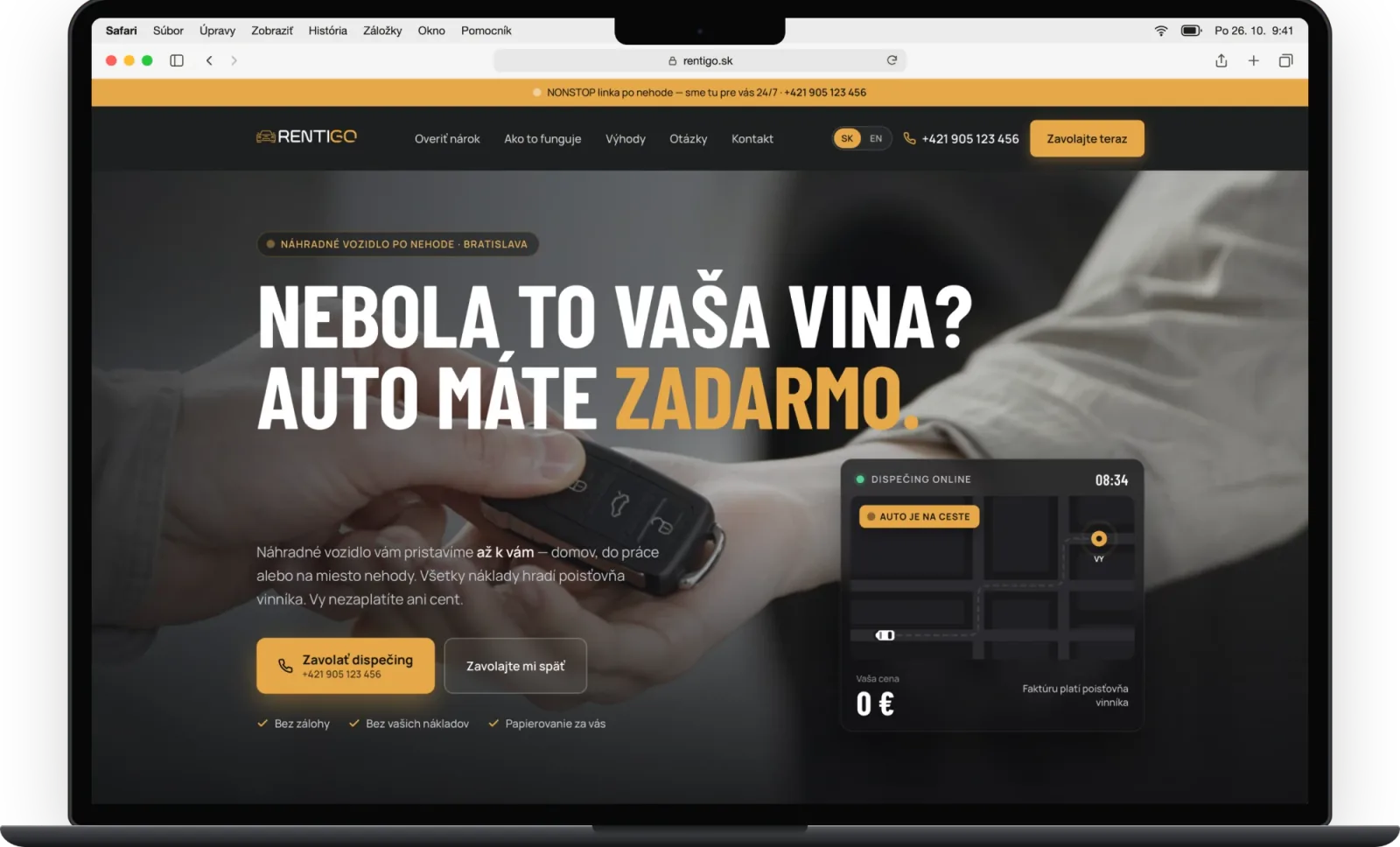
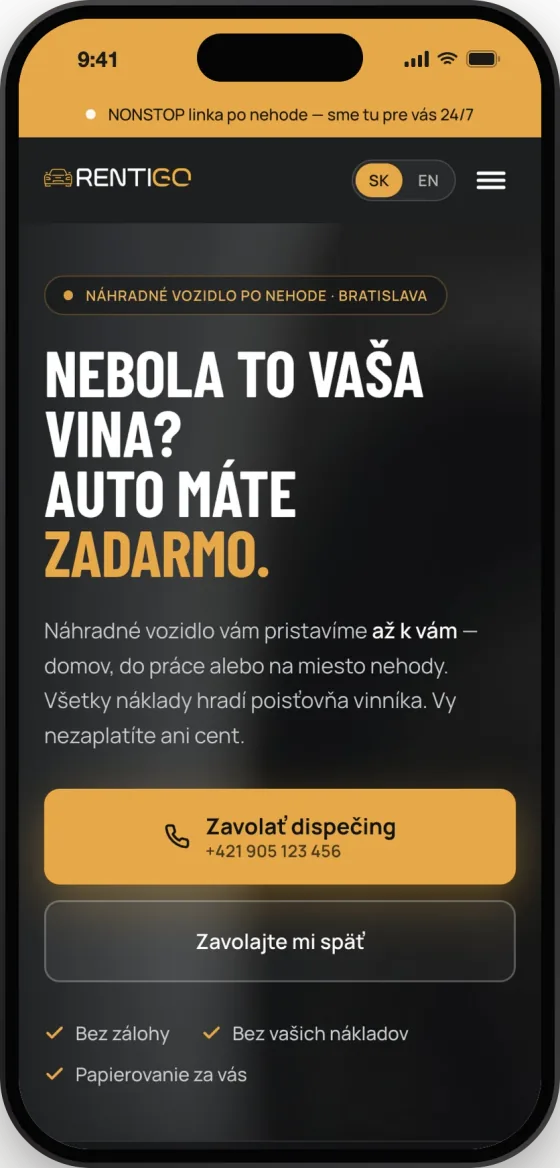
On the Rentigo site for replacement cars after an accident, everything runs in Slovak and English, down to the FAQ and contact page. Nobody under that stress should have to work out where the translation ends.
Hreflang is a short tag in the page code that tells Google: this is the English version of that Slovak page. Visitors never see it, and on its own it will not lift your rankings. A proper hreflang setup needs return links: every version must point to all the others and to itself, or Google may ignore the tags. That is why they belong in the build rather than in manual edits.
A second language is not for everyone.
Worth it when
- Customers abroad or foreigners in Slovakia already contact you, and the site cannot answer them.
- You are entering a new market and want to be found there through Google.
- Someone on your team can reply to an enquiry in each language.
Skip it when
- All your customers read one language and you have no plans beyond it.
- Foreign visitors only need the basics. A single English page with contact details will do.
- Nobody can reply in the other language or keep the translations up to date. Solve that first.
- You run a small WordPress site and a person checks the text. A good plugin is often enough.
How a multilingual site gets built.
- 01
A call about your markets
We work out which markets the site is for and who will answer enquiries, then send a written quote.
- 02
URLs and content plan
We choose the URL structure and decide what appears in every language and what only in some.
- 03
Design for long words
The design takes 3 to 7 days and has to cope with longer text, such as German compounds.
- 04
Build and language versions
Development takes 1 to 3 weeks depending on scope, and we add the text, titles and descriptions for each language.
- 05
Checks and launch
Before launch we test the switcher and forms in every language, then connect the site to Google Search Console.
Questions before you start.
Do we need hreflang with only two languages?
Yes, it is worth having even then. It tells Google the two pages are versions of one another, so people are more likely to land on the right one.
Who provides the translations?
You or your translator supply them and we add them to the site. We advise against machine translation that nobody has checked.
Can you add a language to our current site?
It depends on what the site runs on and how it was built. We look at it first and tell you whether a language can be added cleanly or a new site makes more sense.
How much does each extra language add?
We do not give a fixed figure, because the number of languages is one price factor next to pages, features and who prepares the text. Written quote within 24 hours of a short call.
Which language will we work in?
Calls are in Slovak or English, however many languages the site has. We meet in person in Bratislava, otherwise online on Google Meet.
You may also want to see.
Next step
Tell us which markets you have in mind.
Send us the languages you are considering and who will reply to enquiries in each. We will say how many are worth launching now and what can wait. Written quote within 24 hours of a short call.
Want to talk it through now?Book a free 30-minute call